
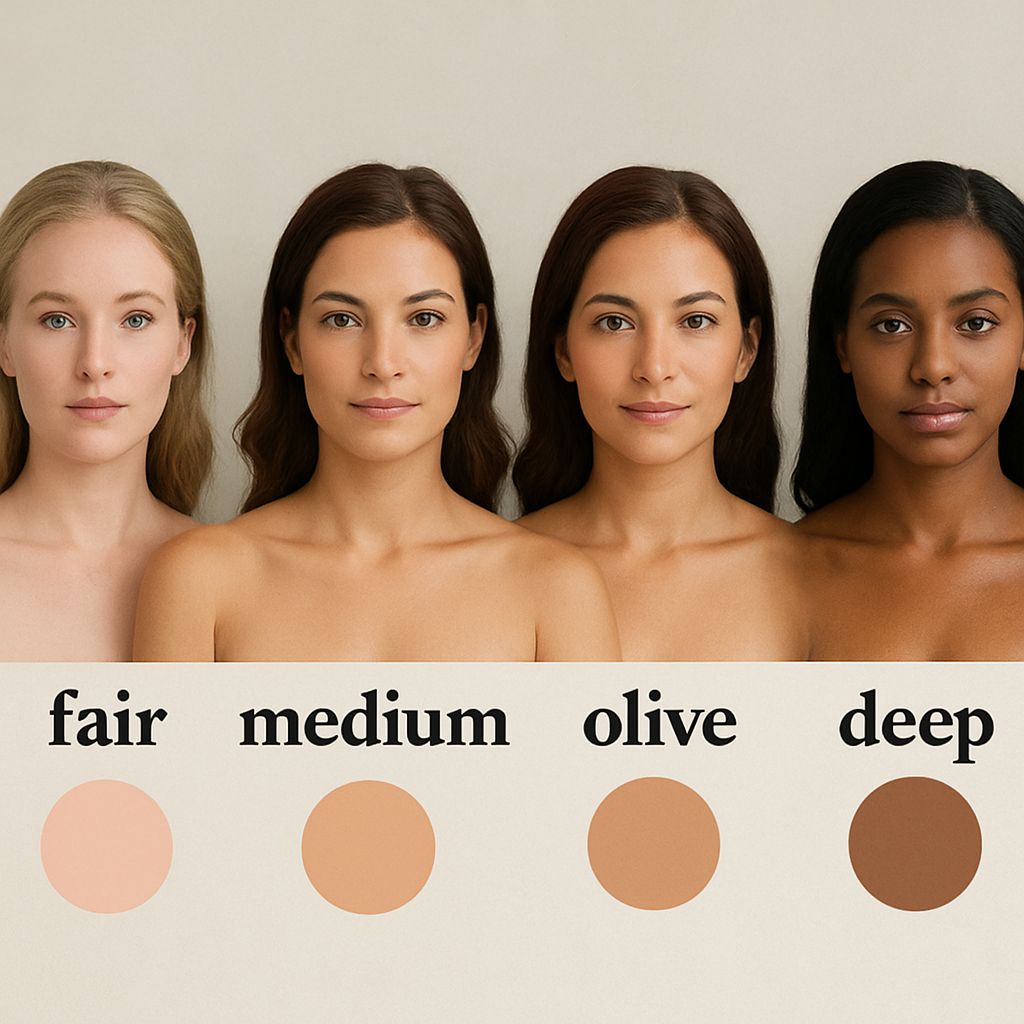
Olive Skin Tone Chart and Skin Undertones Explained
Understanding your undertone changes how you choose foundation, clothing, and hair color. An olive skin tone chart helps identify where olive sits among other complexions, but many people confuse olive with simply having yellow undertone skin. Skin undertones chart resources often separate warm, cool, and neutral categories. Olive actually occupies a specific position, distinct from general warm toned skin. Knowing whether you have pink undertone skin or warm olive undertones makes product selection much more reliable.
This guide breaks down the olive category, explains how undertones work broadly, and shows how to identify your own undertone accurately.
What Are Skin Undertones and Why Do They Matter
Skin tone is what you see on the surface: light, medium, tan, dark. Undertone is the subtle color beneath the surface that doesn’t change with sun exposure. Undertones fall into three broad categories: warm (yellow, peach, gold), cool (pink, red, blue), and neutral (a mix of warm and cool).
Undertones matter because they determine how colors interact with your complexion. A foundation that matches your surface tone but fights your undertone will look off. Clothing colors that clash with your undertone can make skin look dull or unwell. Once you know yours, shopping for beauty products becomes much more predictable.
Where Does Olive Fall on a Skin Tone Chart
On a typical olive skin tone chart, olive occupies a distinct category that bridges warm and neutral. Olive skin has a greenish-yellow undertone that gives it a unique quality: it’s not a pure warm tone (which would be golden or peachy) and not a neutral tone (which would be balanced without the green cast).
Olive skin is sometimes listed as “neutral-warm” or given its own column entirely in skin undertones charts. It tends to range from light-medium to medium-deep in surface tone. The key marker is the greenish quality that appears in poor lighting or when wearing the wrong colors.
Light vs Deep Olive
Light olive skin has the greenish-yellow quality at a lighter depth, similar to many Mediterranean and Middle Eastern complexions. Deeper olive skin sits in the medium-deep range, common across South Asian and Latin American populations. Both share the same undertone character but differ in surface depth.
How Do You Identify Your Own Undertone
Several simple tests help identify undertone:
Vein test: look at the veins on your inner wrist in natural daylight. Blue or purple veins suggest cool undertones; green veins suggest warm undertones. If you see both, you’re likely neutral.
Jewelry test: hold gold and silver jewelry next to your bare face in natural light. If gold looks better, you’re warm or olive. If silver looks better, you’re cool. If both work equally, you’re neutral.
White paper test: hold a pure white piece of paper next to your bare face. Does your skin look more yellow or pink against the white? Yellow suggests warm or olive; pink suggests cool.
Sun reaction: warm and olive tones tend to tan easily and rarely burn. Cool tones tend to burn first or burn without much tanning. This is not definitive but can support other observations.
What Is the Difference Between Warm Toned and Cool Toned Skin
Warm toned skin has yellow, peach, or golden undertones. The skin reads as sunny and tends to look good in earth tones, warm browns, and gold jewelry. When warm toned skin is exposed to poor-fitting colors, it can look muddy or sallow.
Cool toned skin has pink, red, or blue-based undertones. It tends to look fresh and bright in jewel tones, cool blues, and silver jewelry. When exposed to warm, orange-heavy colors, cool skin can look washed out or ruddy.
Olive sits in warm territory but is distinct because of the green component. It’s not purely yellow-warm the way golden or peachy complexions are.
What Characterizes Pink Undertone Skin
Pink undertone skin has a rosy, cool quality. It looks its best in cool colors: dusty rose, berry, cool blue, emerald, and silver-based shades. Foundation with pink or neutral bases will match better than yellow-based options. Pink undertone skin is common in people of Northern European, East Asian, and some African descent.
If you have pink undertone skin and accidentally buy a yellow-based foundation, the mismatch is immediately obvious as an orange or muddy cast. The reverse is also true: yellow-based foundations on pink undertone skin look ashy or dirty.
How Do You Use Your Undertone to Choose Products
For foundation: warm/olive undertones need foundations labeled N (neutral), N/W, or W (warm), with yellow-leaning bases. Cool undertones need C (cool) or P (pink) foundations. Test in natural light on your jawline, not your wrist.
For concealer: match your foundation’s undertone, or go slightly warmer under the eyes to counteract blue-purple circles.
For clothing: warm and olive skin benefits from earth tones, warm jewels, and cream rather than pure white. Cool skin works well with pastels, cool blues, and pure white or black.
Key takeaways: Olive skin has a greenish-yellow undertone that places it in a warm-neutral category on any skin undertones chart. Identifying your undertone through the vein or jewelry test makes product selection far more reliable. Whether your skin reads warm, cool, or olive, working with your undertone rather than against it produces the most flattering results.



Leave a Reply