
Skin Cancer ABCDE Rule: A Complete Guide to Melanoma Detection
Catching melanoma early dramatically improves survival rates — and the skin cancer ABCDE framework gives anyone the tools to perform a meaningful self-examination. Learning the abcd of skin cancer has been a cornerstone of dermatological public health campaigns for decades, and understanding all five letters of the abc skin cancer mnemonic helps you recognize when a mole warrants professional evaluation. The full abcdes of skin cancer system — and even its evolved abcde’s of skin cancer variant that adds evolving changes — empowers patients to catch warning signs earlier.
What Is the ABCDE Rule for Skin Cancer?
The ABCDE rule is a clinical screening mnemonic developed by dermatologists to help both healthcare professionals and the general public evaluate suspicious skin lesions. Each letter corresponds to a characteristic feature of potentially malignant melanoma. It was developed as a systematic, easy-to-remember framework that converts complex dermatoscopic criteria into observable qualities visible to the naked eye. Regular use of this method during self-skin examinations — recommended monthly — allows for earlier detection of changes that might otherwise go unnoticed.
A Is for Asymmetry
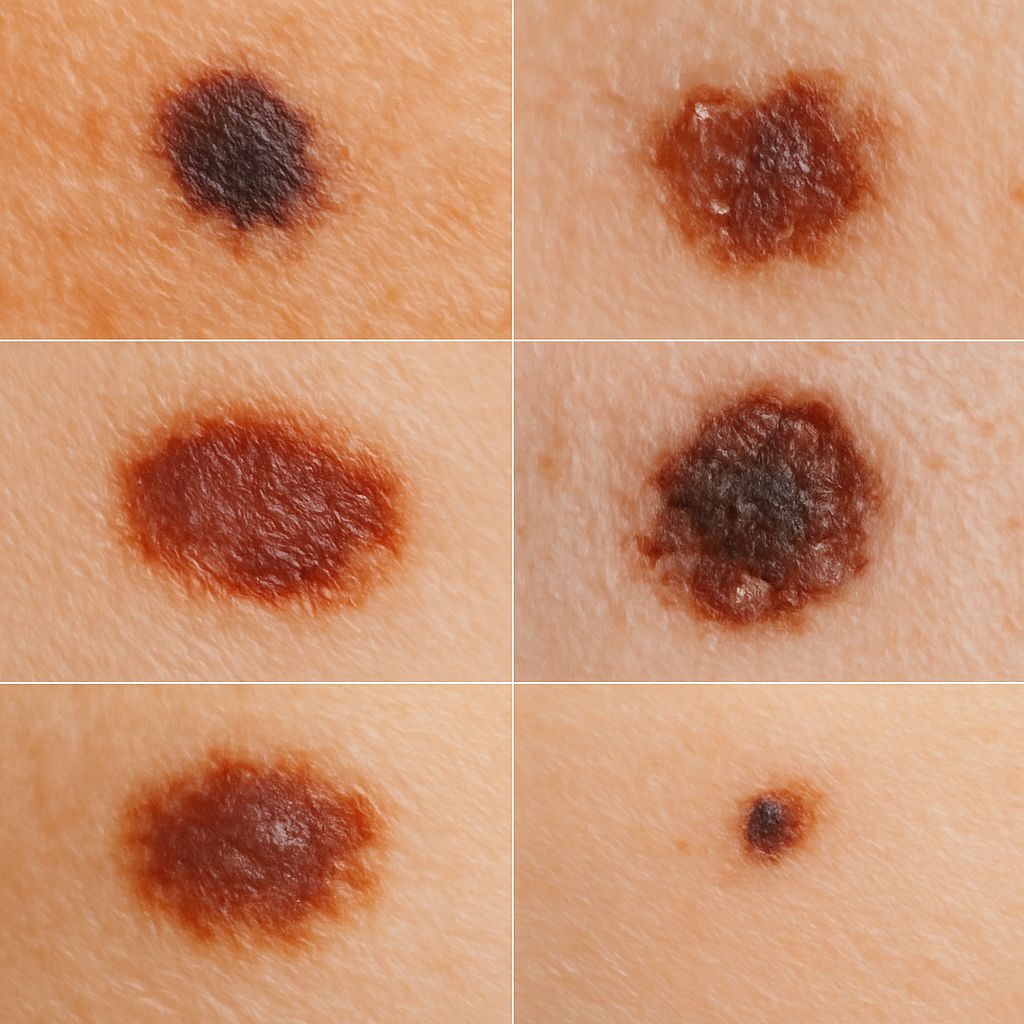
A benign mole is typically symmetrical — if you draw a line through the middle, both halves should match. Melanoma lesions are often asymmetrical: one half does not mirror the other in shape. When evaluating a mole for the abcd of skin cancer criteria, asymmetry is the first and perhaps easiest visual check. Any mole that looks irregular or lopsided warrants closer examination by a dermatologist.
B Is for Border
Benign moles have smooth, well-defined borders. Melanoma frequently presents with ragged, notched, or blurred edges that grade unevenly into surrounding skin. In the abc skin cancer assessment, irregular borders are one of the most reliable visual signals of abnormality. When photographing moles for tracking purposes, the border clarity is one of the most revealing aspects to monitor over time.
C Is for Color
Healthy moles are typically a uniform shade of brown or tan. Melanoma often displays variations in color within a single lesion — mixtures of different shades of brown and black, with possible areas of red, white, or blue-black. Multiple colors within a single mole are a significant warning sign in the abcdes of skin cancer framework. Even a single mole with two distinctly different color zones warrants professional evaluation.
D Is for Diameter
Most melanomas are larger than 6 millimeters (roughly the size of a pencil eraser) when first detected. However, this criterion is considered the weakest of the ABCDE parameters — many melanomas are detected at smaller diameters, and some benign lesions exceed 6 mm. When using the abcde’s of skin cancer checklist, diameter should always be considered in conjunction with the other four criteria rather than evaluated in isolation.
E Is for Evolving
Any mole that is changing in size, shape, color, or elevation over weeks or months requires immediate evaluation. The evolving criterion was added to the original ABCD rule to create the full five-point system, because change over time is often the most sensitive indicator of malignant transformation. Track moles with photographs taken at regular intervals under consistent lighting to detect evolving changes that might be subtle on casual inspection. New symptoms such as bleeding, itching, or crusting in an existing mole also qualify as evolving changes.
Beyond ABCDE: The EFG Rule and Other Warning Signs
Nodular melanoma — a particularly aggressive subtype — sometimes does not present with classic ABCDE features. The EFG rule (Elevated, Firm, Growing) was developed to capture this subtype. Similarly, amelanotic melanoma lacks pigment and may appear as a pink, red, or flesh-colored lesion without the color variation typical of ABCDE criteria. These exceptions underscore the importance of professional full-body skin examinations annually, regardless of personal self-screening results.
When to See a Dermatologist
Any mole that meets one or more ABCDE criteria — particularly evolving lesions — should be evaluated by a board-certified dermatologist without delay. Do not attempt to self-diagnose or self-treat suspicious lesions. Dermatoscopy (dermoscopy), the clinical use of a magnifying instrument with polarized light, allows dermatologists to see structural features invisible to the naked eye, significantly improving early detection accuracy beyond what the ABCDE checklist alone can achieve.
Bottom line: The ABCDE framework is a valuable screening tool, not a diagnostic one. Use it to identify lesions that need professional attention, not to rule out cancer. Annual dermatologist visits for full-body skin checks are the gold standard for melanoma detection.





Leave a Reply