
ABCs of Skin Cancer: The ABCDE Assessment Guide for Mole Detection
Melanoma is one of the most preventable forms of cancer when caught early — and the abcs of skin cancer provide a simple, memorable framework for identifying suspicious moles at home. The abc’s of skin cancer checklist has evolved over the years, with the addition of D and E expanding the original three-letter system into the comprehensive abcde skin assessment used by dermatologists today. Understanding the abcd rule for skin cancer — and its five-criterion expansion — is valuable for anyone who performs regular self-examinations. The full abcds of skin cancer criteria together create a powerful early detection tool accessible to everyone.
The Origin and Purpose of the Skin Cancer ABCDE Framework
The ABCDE rule was developed in the 1980s by dermatologists at NYU as a way to translate complex dermoscopic criteria into a framework usable by non-specialists. Originally published as an ABCD system, the “E for Evolving” criterion was added later when research confirmed that change over time was among the most sensitive indicators of melanoma. Today, the full five-point system is used in medical education, patient education materials, and self-screening programs globally. It is taught as a foundational concept in dermatology, oncology, and general medicine training worldwide.
A: Asymmetry in the ABCs of Skin Cancer
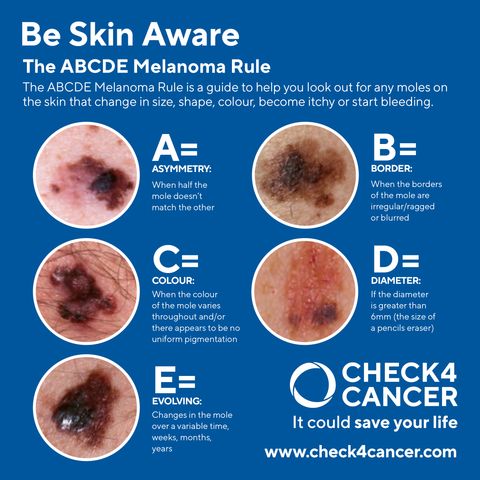
In the abcs of skin cancer framework, asymmetry refers to the shape characteristics of a mole when divided by an imaginary center line. A benign mole’s two halves should mirror each other closely. Melanoma lesions frequently grow in irregular patterns, with one half appearing distinctly different in shape, size, or elevation from the other. When assessing asymmetry, mentally draw a line through the center of the lesion both horizontally and vertically — both axes should show reasonable symmetry in a benign mole.
B: Border Irregularity in the ABCD Rule for Skin Cancer
The abcd rule for skin cancer uses border characteristics as its second criterion. Benign moles have smooth, clearly defined edges that transition sharply and evenly from the mole’s pigment to the surrounding normal skin. Melanoma borders are often described as notched, scalloped, irregular, or poorly defined — appearing to bleed into the surrounding skin with blurred or ragged edges. Photographing a mole under consistent lighting and comparing images over time can reveal subtle border changes not obvious in a single evaluation.
C: Color Variation in the ABCDE Skin Assessment
Normal moles are a single, uniform shade of tan or brown. In the abcde skin assessment, color variation within a single lesion is a significant warning sign. Melanoma may display multiple shades of brown, black, red, white, or blue-black within the same lesion. Even two distinct shades of brown within a single mole warrant evaluation. The presence of white areas (representing regression — areas where the immune system has attacked the tumor) or blue-black areas is particularly concerning.
D: Diameter in the ABCDs of Skin Cancer
The abcds of skin cancer diameter criterion flags lesions larger than 6 millimeters (the size of a standard pencil eraser). While many early melanomas are detected at smaller sizes, diameter remains useful as a general guide — particularly for tracking growth over time. A mole that was previously stable and small but has grown beyond 6 mm should be evaluated even if it shows no other ABCDE criteria. Conversely, a large stable mole present since childhood with consistent shape and color is less concerning than a smaller lesion showing other warning criteria.
E: Evolving — The Most Sensitive Criterion
Any change in a mole — in size, shape, color, elevation, or associated symptoms (itching, bleeding, crusting, oozing) — qualifies as the E criterion. Evolving lesions are considered the highest-priority indication for dermatological evaluation in the ABCDE system. The “E” was added because research showed that patients who noticed change were more likely to present with earlier-stage melanoma. Take monthly photographs of moles under consistent lighting to objectively track evolution — subjective memory of how a mole looked six months ago is unreliable.
Beyond ABCDE: The Ugly Duckling Sign
A complementary screening tool to the ABCDE framework is the “Ugly Duckling” sign — any mole that looks distinctly different from others on your body deserves evaluation regardless of whether it meets specific ABCDE criteria. Most people’s moles share a family resemblance in size, color, and shape. An outlier that appears darker, larger, or differently textured than surrounding moles is the “ugly duckling” and should be professionally assessed.
Safety recap: The ABCDE and ABC’s of skin cancer framework is a screening tool, not a diagnostic one. A mole meeting one or more criteria does not necessarily mean it is cancerous — but it does mean it warrants professional evaluation. Annual full-body skin checks with a board-certified dermatologist remain the gold standard for melanoma detection.





Leave a Reply