

Tea tree oil for skin tags has been a popular home remedy for decades, and the anecdotal record of people who claim it removed their skin tags is extensive. However, understanding whether tea tree oil actually removes skin tags, under what conditions it works best, and how to apply it correctly prevents both disappointment and skin injury. The short answer is that tea tree oil and skin tags can be an effective combination for small, pedunculated tags, but it requires consistent application over several weeks and will not work for larger or deeply based growths.
Knowing does tea tree oil remove skin tags with certainty requires understanding what skin tags are: soft, flesh-colored benign growths made of loosely arranged collagen fibers and blood vessels covered by epidermis. Knowing how to remove skin tags with tea tree oil safely means diluting it properly, applying it consistently, and knowing when to stop and see a dermatologist instead. How to use tea tree oil for skin tags correctly determines whether you get results or an irritated patch of skin with the tag still attached.
What the Evidence Says About Tea Tree Oil and Skin Tags
Clinical research specifically on tea tree oil as a skin tag treatment is limited. Existing studies focus more on its antimicrobial and anti-inflammatory properties. The mechanism proposed for skin tag removal using tea tree oil is desiccation: the oil’s terpinen-4-ol content is thought to dry out the tissue over repeated applications, causing the stalk to shrink and the tag to fall off. This mechanism is similar to the way dermatologists use cryotherapy to freeze and destroy benign growths. While the chemistry is plausible, individual results vary considerably based on tag size, location, and frequency of application.
How to Remove Skin Tags with Tea Tree Oil: Step-by-Step
Dilution Ratios
Undiluted tea tree oil is too concentrated for direct skin application. A safe working dilution for skin tag treatment is typically 1 part tea tree oil to 3 parts carrier oil, such as jojoba, coconut, or almond oil. This produces a roughly 25 percent concentration that delivers active compounds while reducing the risk of contact dermatitis that undiluted application commonly causes.
Application Method
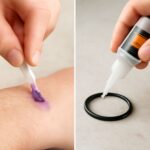
Apply the diluted mixture to the skin tag using a cotton swab. Press the swab directly onto the tag rather than the surrounding skin to minimize unnecessary exposure of healthy tissue. Cover with a small adhesive bandage to hold the oil in contact and protect the area from clothing friction. Repeat two to three times daily for four to six weeks. Track progress by photographing the tag weekly; if it is responding, it will gradually shrink, darken, and eventually fall off.
What Results to Expect
Small skin tags under 5 mm respond most reliably to consistent tea tree oil applications. Larger tags rarely respond completely to topical treatment and may need professional removal. If the tag increases in size, becomes painful, or bleeds, stop application and seek dermatological evaluation, as these changes can occasionally signal that what was assumed to be a benign tag is actually a different type of lesion.
Situations Where Tea Tree Oil Is Not Appropriate
Tea tree oil treatment is not suitable for skin tags on the eyelids, inside the nostrils, or near mucous membranes, where the oil can cause significant irritation or toxicity if it enters the eye or is inhaled in quantity. It is also not appropriate for skin tags in areas of high friction like the groin or underarm where bandaging is impractical and the area stays moist, creating conditions where the diluted oil cannot work effectively. Children under 10 and people with known tea tree allergy should avoid this approach entirely.
Professional Alternatives Worth Considering
Dermatologists remove skin tags quickly using three main techniques: cryotherapy, which freezes the tag with liquid nitrogen; cauterization, which uses an electrical current to burn the tag off; and simple ligation or excision. All three methods are faster and more reliable than topical tea tree oil, particularly for tags larger than a few millimeters. Most skin tag removal is considered cosmetic and may not be covered by insurance, but the cost of a single dermatology visit for tag removal is often comparable to weeks of purchasing tea tree oil products.
Monitoring and When to Seek Medical Evaluation
Any growth that changes rapidly in color, size, or texture, bleeds spontaneously, becomes tender, or has an irregular border should be evaluated by a dermatologist before any home treatment is attempted. Melanoma and other skin cancers can occasionally be mistaken for skin tags, particularly in their early stages. Having any new or changing growth examined professionally before self-treating protects against treating a potentially serious condition with a home remedy that delays diagnosis.
Safety recap: Always dilute tea tree oil before applying it to skin; undiluted application causes chemical burns and contact dermatitis in a significant proportion of users. Never apply tea tree oil near the eyes, mouth, or mucous membranes. If the skin around the tag becomes significantly red, swollen, or blistered during treatment, discontinue use and consult a dermatologist.




Leave a Reply